

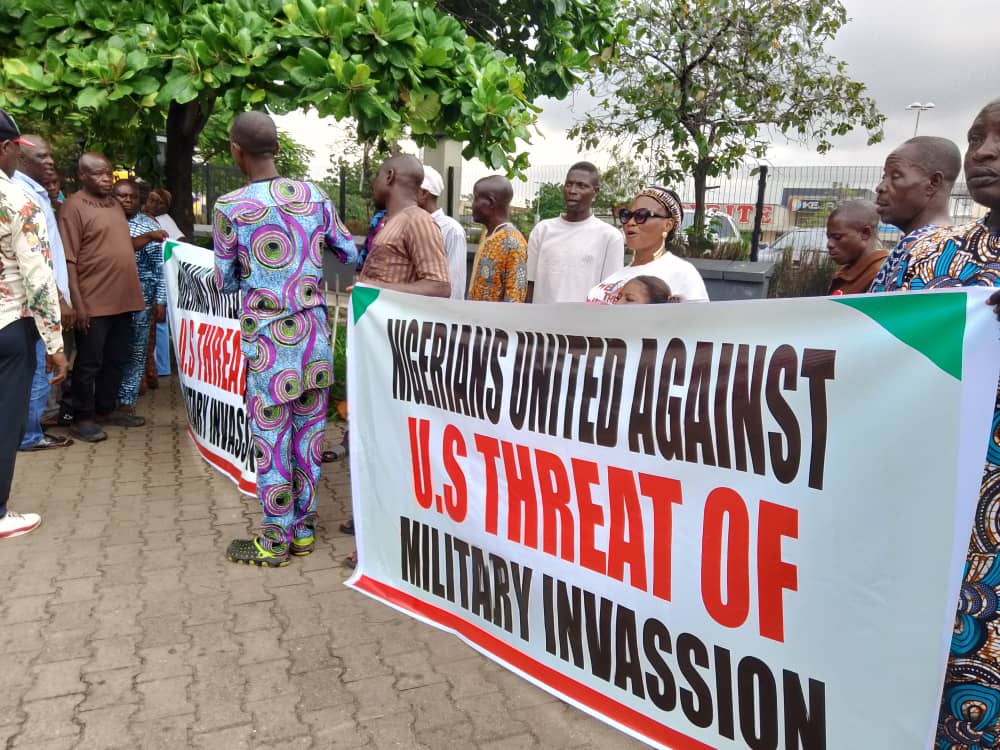


In a quick reaction to the recent threat of invasion on Nigeria by the United States of America, the Human Rights Monitoring Agenda (HURMA Global Resource Initiative) recently led members of Nigerian Civil Society Organizations under the name of Coalition of Civil Society Groups in Nigeria (CCSGN) with other concerned Nigerians including Christian religious faiths from different formations, a protest carried out Thursday, 7th of November to the Lagos State House of Assembly to submit a petition with a request for transmission of same to the United States Congress through the President of the Senate, Federal Republic of Nigeria.


The petition was signed by the Executive Director of HURMA, Comrade Buna Olaitan Isiak alongside other leaders that formed the coalition.

See full petition:
PETITION TO THE UNITED STATES CONGRESS
Against President Donald J. Trump’s Military Threats and the Unjust Designation of Nigeria as a “Country of Particular Concern”
Submitted by the Coalition of Civil Society Groups in Nigeria
Date: November 2025
Introduction
We, the undersigned members of the Coalition of Civil Society Groups in Nigeria, write to express our deep concern over recent inflammatory statements by former U.S. President Donald J. Trump, threatening possible military action in Nigeria under the pretext of protecting Christians, and over the unjust designation of Nigeria as a “Country of Particular Concern” (CPC) under the International Religious Freedom Act.
These developments represent an affront to Nigeria’s sovereignty, an insult to our democratic integrity, and a serious threat to peace, security, and stability across West Africa. We call upon the United States Congress to act responsibly by repudiating these reckless threats and reviewing the baseless designation that paints a distorted image of our nation.
- Nigeria’s Democracy and Religious Freedom
Nigeria is a vibrant democracy governed by a constitutional framework that guarantees freedom of religion, belief, and association to all citizens. Since returning to democratic governance in 1999, we have conducted free and fair elections every four years, with peaceful transitions of power.
No Nigerian leader holds office for life. Our democracy, though imperfect, continues to deepen through the will of the people.
Religious diversity is one of Nigeria’s greatest strengths. Christians and Muslims coexist in every part of the country, while millions also practice traditional faiths. Nigeria’s federal and state institutions reflect this pluralism, and successive governments — including the current administration — have worked closely with religious and community leaders to promote tolerance and peaceful coexistence.
- Misrepresentation of Religious Persecution
The narrative that Nigeria persecutes Christians is false and misleading. Nigeria’s security challenges — including terrorism, banditry, and communal violence — affect citizens of all faiths.
Extremist groups such as Boko Haram and ISWAP have killed far more Muslims than Christians, as their strongholds are in predominantly Muslim northern states. Likewise, armed bandits in the Northwest have attacked Muslim and Christian communities alike.
The portrayal of Nigeria as a state-driven violator of religious freedom is, therefore, a distortion of facts. These are security challenges rooted in poverty, extremism, and governance gaps — not in state-sponsored religious persecution.
- The Dangers of Foreign Military Threats
Mr. Trump’s statement threatening military intervention in Nigeria, allegedly to “protect Christians,” is both irresponsible and unlawful. It constitutes a violation of the United Nations Charter, which prohibits the use or threat of force against the territorial integrity or political independence of any state. It also contravene the principles of the African Union Constitutive Act, which upholds sovereignty and non-interference in the internal affairs of member states.
History offers painful lessons from similar interventions in Iraq, Libya, Syria, and Afghanistan — nations devastated under the banner of “liberation” and “protection.” Such actions have never delivered peace, only chaos and lasting instability.
Nigeria does not require foreign bombs or boots on its soil. What we need is international cooperation, intelligence support, and developmental partnerships to help our government defeat terrorism and strengthen the rule of law.
- Economic Repercussions and Investor Anxiety
The reckless rhetoric and hostile designation have already generated investor anxiety and negatively impacted Nigeria’s economic outlook. Nigeria has made tremendous progress in stabilizing its currency, rebuilding its foreign reserves, and reviving domestic production capacity
- Economic Repercussions and Investor Anxiety
The reckless rhetoric and hostile designation have already generated investor anxiety and negatively impacted Nigeria’s economic outlook. Nigeria has made tremendous progress in stabilizing its currency, rebuilding its foreign reserves, and reviving domestic production capacity — including refining and export of petroleum products.
Threats of sanctions or military intervention send the wrong signal to international markets and hinder the efforts of millions of Nigerians striving for economic renewal. Constructive partnership, not coercion, should define U.S.–Nigeria relations.
- Appeal to the United States Congress
We respectfully urge the United States Congress to:
- Condemn and repudiate any military threats or coercive rhetoric directed at Nigeria.
- Review and reverse Nigeria’s wrongful designation as a “Country of Particular Concern.”
- Support diplomatic engagement and fact-based assessment of Nigeria’s human rights and religious freedom record.
- Encourage cooperative counterterrorism assistance and capacity-building programs rather than punitive measures.
- Affirm the principles of sovereignty, mutual respect, and partnership that have long guided U.S.–Africa relations.
- Nigeria’s Commitment to Peace and Progress
The Federal Government of Nigeria, under President Bola Ahmed Tinubu, continues to work with Christian, Muslim, and traditional leaders to promote interfaith understanding and to respond to the security challenges facing our nation. Civil society organizations across the country are equally engaged in peacebuilding, human rights advocacy, and social justice campaigns.
We reaffirm that Nigeria stands for peace, unity, and democratic governance. We value our partnership with the United States and remain open to dialogue rooted in truth, respect, and equality.
Conclusion
Nigeria is not a land of religious persecution but a democracy confronting terrorism and insecurity like many others. The Trump-era threats of invasion and the baseless CPC designation are unjust, dangerous, and damaging to the friendship between our peoples.
We, the Coalition of Civil Society Groups in Nigeria, reject these threats and call on the U.S. Congress to defend the principles of international law, truth, and mutual respect.
Together, let us build bridges of peace, not walls of misinformation or hostility.